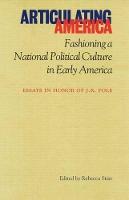
Articulating America: Fashioning a National Political Culture
J. G. A. PocockRebecca StarrJoyce ApplebyLawrence GoldmanJack GreeneAndrew RobertsonRichard Vernier
2001
Genres: PoliticsSociety & Culture
Seven distinguished historians explain how a national political culture developed in America. A political culture is both the collectivity of a community's values and a mode of behavior—an end as well as a process of obtaining that end which is always changing. J.G.A. Pocock examines how Americans wrote their own history rather than relying on others. Jack Greene shows how British institutions and the common law were modified by unique colonial American experiences. Richard Vernier suggests that the economic crises of the mid-1780s resulted in the triumph of a national fiscal policy enunciated by Alexander Hamilton. Andrew Robertson demonstrates how election rituals transformed the American political culture of deference into an expanded, abstract world of electoral opinion knit together by newspapers. Joyce Appleby examines the importance of literacy to the exchange of ideas that created a national political culture. She also highlights the importance of volunteer associations to effect social and economic reform in America (including the abolition of slavery). Lawrence Goldman's case study of the National Reform Association, a nineteenth-century group of radical workers, describes how the reform movement's advocacy of cheap land led to the passage of the Homestead Act in 1862. Rebecca Starr uses South Carolina to illustrate how the South developed its own political culture by the end of the eighteenth century that persisted well beyond the Civil War.
Write a comment/review
Sign UpLogin
User name
0 reviews
165 followers
PlaceholderPlaceholder
User name
0 reviews
165 followers
PlaceholderPlaceholder
User name
0 reviews
165 followers
PlaceholderPlaceholder
User name
0 reviews
165 followers
PlaceholderPlaceholder
User name
0 reviews
165 followers
PlaceholderPlaceholder
1.2.3.4.5.6