Loading...
Book NameAuthor Names2024
Genres: List of Genres
PlaceholderPlaceholderPlaceholderPlaceholder
PlaceholderPlaceholderPlaceholder
Write a comment/review
Your rating
Post
User name
0 reviews
165 followers
PlaceholderPlaceholder
July 31, 2026
User name
0 reviews
165 followers
PlaceholderPlaceholder
July 31, 2026
User name
0 reviews
165 followers
PlaceholderPlaceholder
July 31, 2026
User name
0 reviews
165 followers
PlaceholderPlaceholder
July 31, 2026
User name
0 reviews
165 followers
PlaceholderPlaceholder
July 31, 2026
1.2.3.4.5.6
Exclusive savings
instagram
facebook
twitter
linkdin
linkdin
tiktok
threads

COMPANY

  • About Us
  • Contact Us
  • Partners
  • FAQ

EXPLORE

  • Book Clubs
  • How It Works
  • Genres

LEGAL

  • Privacy Policy
  • Terms and Conditions
  • Cookie Policy
  • Data and Privacy Preferences

CONNECT

  • Newsletter Signup
  • Affiliate Programme
  • Blog / Editorial
Powered by World Privilege Plus
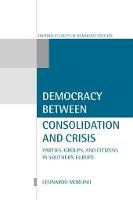
Democracy Between Consolidation and Crisis: Parties, Groups, and Citizens in Southern Europe

Democracy Between Consolidation and Crisis: Parties, Groups, and Citizens in Southern Europe

Leonardo Morlino

1998

Genres: Politics

The second half of the twentieth century has witnessed several waves of democratization in Europe, the Americas, and in other regions of the world, such as South East Asia. Although for the most part these democratic regimes are no longer haunted by the prospect of a return to authoritarianism, severe economic and social problems have posed serious challenges, creating a situation where change is often achieved through alternating periods of consolidation and crisis. Drawing on a systematic, empirical analysis of four key Southern European countries, Portugal, Spain, Greece, and Italy, Morlino identifies several key aspects of democratic consolidation: consensus and legitimation, party system and party organization, and the ways in which organized and non-organized interests are related to parties and the institutions of state. The resulting models of consolidation are analysed and the mechanisms and patterns of their unfolding crises identified, taking care to disentangle the pragmatic reactions against the regime, often related to corruption, from more ideological ones grounded in differences in values. Finally, the author addresses the question of the `quality' of democracy, examining how this is related to the outcome of processes of consolidation and crisis. This insightful study offers the first extensive, comparative analysis of consolidation and crisis in these countries, and features a wealth of up-to-date information on party organizations, interest associations, the media, and public opinion. Although clearly focusing on Southern Europe, the author's findings are extremely relevant for understanding the politics of several other regions, including Eastern Europe, Latin America, and South East Asia.

Want to ReadMark as ReadReviewsEdit

Write a comment/review

Sign UpLogin
User name
0 reviews
165 followers
PlaceholderPlaceholder
July 31, 2026
User name
0 reviews
165 followers
PlaceholderPlaceholder
July 31, 2026
User name
0 reviews
165 followers
PlaceholderPlaceholder
July 31, 2026
User name
0 reviews
165 followers
PlaceholderPlaceholder
July 31, 2026
User name
0 reviews
165 followers
PlaceholderPlaceholder
July 31, 2026
1.2.3.4.5.6
Exclusive savings
BookfellersBeta
  • Clubs
Sign Up
Sign in
Add a book club
|Join a club
|
|
|
|eBooks
|Bookfellers rewards
Reader's Voices
Reader's Voices
Join a club
Join a club
Children
Children
Non-Fiction
Non-Fiction
Fiction
Fiction
eBooks
eBooks
Bookfellers rewards
Bookfellers rewards