Loading...
Book NameAuthor Names2024
Genres: List of Genres
PlaceholderPlaceholderPlaceholderPlaceholder
PlaceholderPlaceholderPlaceholder
Write a comment/review
Your rating
Post
User name
0 reviews
165 followers
PlaceholderPlaceholder
July 31, 2026
User name
0 reviews
165 followers
PlaceholderPlaceholder
July 31, 2026
User name
0 reviews
165 followers
PlaceholderPlaceholder
July 31, 2026
User name
0 reviews
165 followers
PlaceholderPlaceholder
July 31, 2026
User name
0 reviews
165 followers
PlaceholderPlaceholder
July 31, 2026
1.2.3.4.5.6
Exclusive savings
instagram
facebook
twitter
linkdin
linkdin
tiktok
threads

COMPANY

  • About Us
  • Contact Us
  • Partners
  • FAQ

EXPLORE

  • Book Clubs
  • How It Works
  • Genres

LEGAL

  • Privacy Policy
  • Terms and Conditions
  • Cookie Policy
  • Data and Privacy Preferences

CONNECT

  • Newsletter Signup
  • Affiliate Programme
  • Blog / Editorial
Powered by World Privilege Plus
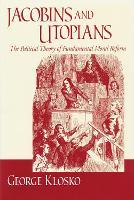
Jacobins and Utopians: The Political Theory of Fundamental Moral Reform

Jacobins and Utopians: The Political Theory of Fundamental Moral Reform

George Klosko

2003

Genres: PoliticsPhilosophy

Jacobins and Utopians examines the politics of ideal societies and the means necessary to bring them into existence. George Klosko reveals how discussions of fundamental moral reform lead inexorably to questions of political power. Machiavelli classically articulated the claim that unarmed prophets go to the gallows. Themes of revolution play an integral role in Klosko's study—as the figures he explores frequently concerned themselves with the means of becoming armed. Klosko focuses particularly on what he calls "educational realism" as a means of channeling political power in pursuit of moral reform. If people are to become fit for an ideal society they must be subjected to intensive education, which in turn requires control of the educational environment and, consequently, of society as a whole. Klosko identifies Plato as an educational realist and contends that Plato, contrary to his reputation as a pure utopian, actually provides a searching analysis of the role of political power in fundamental moral reform. In addition to Plato, Jacobins and Utopians canvasses strategies of moral reform proposed by Plutarch's Lycurgus, Socrates, Thomas More, Machiavelli, Robespierre, Saint-Just, Bakunin, Charles Fourier, Marx, and Lenin. Klosko analyzes both the advantages of Jacobinism as a political strategy and its inherent flaws.

Want to ReadMark as ReadReviewsEdit

Write a comment/review

Sign UpLogin
User name
0 reviews
165 followers
PlaceholderPlaceholder
July 31, 2026
User name
0 reviews
165 followers
PlaceholderPlaceholder
July 31, 2026
User name
0 reviews
165 followers
PlaceholderPlaceholder
July 31, 2026
User name
0 reviews
165 followers
PlaceholderPlaceholder
July 31, 2026
User name
0 reviews
165 followers
PlaceholderPlaceholder
July 31, 2026
1.2.3.4.5.6
Exclusive savings
BookfellersBeta
  • Clubs
Sign Up
Sign in
Add a book club
|Join a club
|
|
|
|eBooks
|Bookfellers rewards
Reader's Voices
Reader's Voices
Join a club
Join a club
Children
Children
Non-Fiction
Non-Fiction
Fiction
Fiction
eBooks
eBooks
Bookfellers rewards
Bookfellers rewards